Skip to content
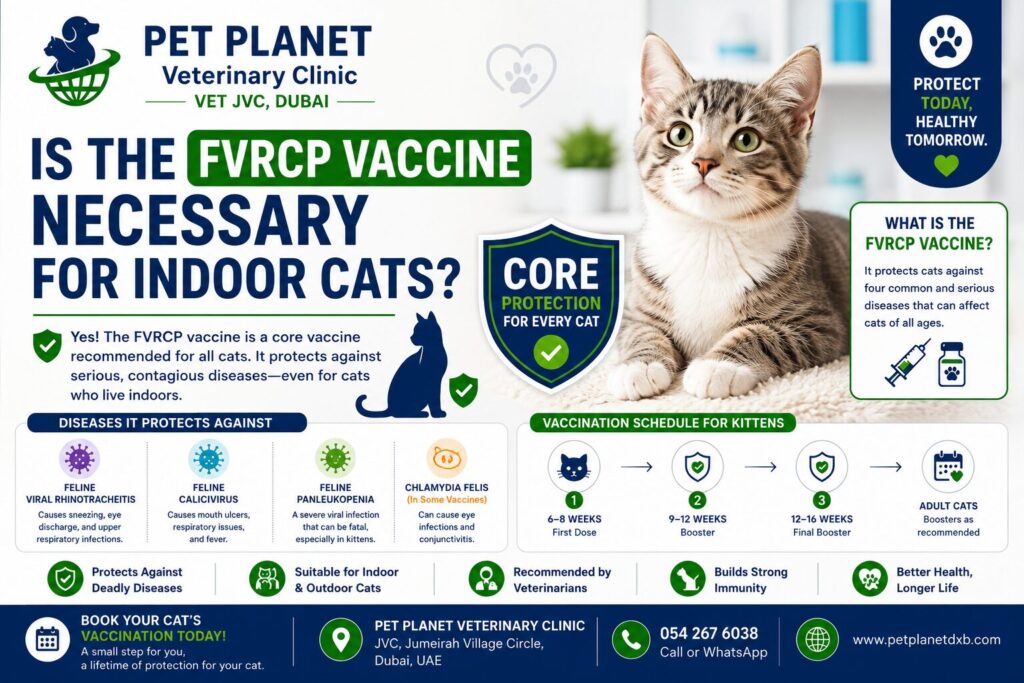
Is the FVRCP Vaccine Necessary for Indoor Cats?
Yes. Every major veterinary body, including WSAVA and AAFP, classifies FVRCP as a core vaccine for all cats, indoor or outdoor, because the diseases it prevents can enter a home through routes that have nothing to do with going outside. “My cat never goes outside, so why does she need vaccines?” It’s one of the most common questions we hear at Pet Planet Veterinary Clinic in JVC, Dubai, and it’s a completely reasonable one to ask. If your cat spends her entire life inside your apartment or villa, it seems logical that she’d be shielded from the diseases that outdoor cats face. But feline viral rhinotracheitis, calicivirus, and panleukopenia — the three diseases the FVRCP vaccine protects against — don’t need your cat to go outdoors at all. They travel on shoes, hands, clothing, carriers, and even through the air in a building’s shared ventilation. Some of them can survive on a hard surface for over a year, waiting for a host. This article walks through exactly what the FVRCP vaccine protects against, how indoor cats are realistically exposed to these diseases, what veterinarians actually recommend and why, the vaccination schedule for kittens and adult cats, the real risks of skipping it, and what all of this means specifically for cat owners living in Dubai and the wider UAE. What Is the FVRCP Vaccine? FVRCP is a combination vaccine that protects cats against three highly contagious viral diseases: feline viral rhinotracheitis, feline calicivirus, and feline panleukopenia. It is considered a core vaccine, meaning veterinary organizations recommend it for every cat regardless of lifestyle. The letters in FVRCP each stand for a specific pathogen: F – Feline (indicating the vaccine targets feline-specific viruses) VR – Viral Rhinotracheitis (caused by feline herpesvirus type 1) C – Calicivirus P – Panleukopenia (also known as feline distemper or feline parvovirus) These three diseases are grouped into a single vaccine because they’re all highly contagious, widespread in the general cat population, and capable of causing serious illness or death — particularly in kittens, senior cats, and cats with weakened immune systems. Feline Viral Rhinotracheitis (FVR) Feline viral rhinotracheitis is caused by feline herpesvirus type 1 (FHV-1), a virus that primarily affects the upper respiratory tract and eyes. Symptoms typically include sneezing, nasal discharge, conjunctivitis, excessive tearing, corneal ulcers, and loss of appetite due to a reduced sense of smell. In severe cases, especially in young kittens, pneumonia can develop. Transmission happens through direct contact with an infected cat’s saliva, nasal discharge, or eye secretions. It also spreads through contaminated surfaces such as food bowls, bedding, litter boxes, and human hands or clothing that carried the virus from one cat to another. Severity varies widely. A healthy adult cat may experience a mild, self-limiting illness, but kittens, senior cats, and immunocompromised cats can develop serious complications. One especially frustrating feature of FHV-1 is that it establishes lifelong latent infection in most cats that recover — meaning the virus can reactivate during periods of stress and cause recurring flare-ups for the rest of the cat’s life. Feline Calicivirus (FCV) Feline calicivirus is another major cause of upper respiratory disease in cats, though it tends to produce a somewhat different symptom profile than FHV-1. Symptoms commonly include oral ulcers, drooling, sneezing, nasal discharge, and sometimes lameness caused by a transient, virus-associated arthritis. Some strains also cause gingivostomatitis, a painful chronic inflammation of the gums and mouth. Complications can be severe. A particular hypervirulent strain of calicivirus (often referred to as FCV-VSD, virulent systemic disease) can cause high fever, swelling, organ damage, and death even in previously healthy, fully vaccinated adult cats. Outbreaks of this strain have occurred in shelters, multi-cat households, and boarding facilities. Transmission occurs through direct contact with infected saliva, ocular, or nasal secretions, as well as through contaminated objects. Calicivirus is notably hardy in the environment compared to many other viruses, which increases the risk of indirect transmission through shared items like grooming tools, carriers, or bedding. Feline Panleukopenia (FPV) Feline panleukopenia, sometimes still called “feline distemper,” is caused by feline parvovirus and is widely regarded by veterinarians as the most dangerous of the three FVRCP diseases. Mortality in unvaccinated kittens can exceed 90% in some outbreak settings, largely because the virus attacks rapidly dividing cells, devastating the intestinal lining and bone marrow. This leads to severe vomiting, bloody diarrhea, dehydration, and a dangerous drop in white blood cells, leaving the body unable to fight off secondary infections. Environmental survival is the feature that makes panleukopenia particularly relevant to indoor cats. The virus can persist on surfaces, bedding, and in soil for many months, and in some conditions over a year. It resists many common household disinfectants, which is why veterinary clinics use specific parvovirus-effective cleaning protocols. Why it’s considered one of the most dangerous feline diseases: the combination of extreme environmental persistence, high contagiousness, and severe mortality in unprotected cats means panleukopenia doesn’t require ongoing outdoor exposure to become a real threat — a single contaminated item brought into a home can be enough. FVRCP Diseases Compared Disease Cause How It Spreads Severity Prevention Viral Rhinotracheitis Feline herpesvirus type 1 Direct contact, contaminated surfaces, respiratory secretions Mild to moderate in adults; can be severe in kittens; causes lifelong latent infection FVRCP vaccine, stress reduction to prevent flare-ups Calicivirus Feline calicivirus Direct contact, contaminated objects, airborne droplets at close range Moderate; virulent strains can be fatal even in vaccinated adults FVRCP vaccine, hygiene in multi-cat environments Panleukopenia Feline parvovirus Contact with infected feces, bodily fluids, or contaminated environments/objects Severe; often fatal in unvaccinated kittens FVRCP vaccine, environmental decontamination Why Many Owners Believe Indoor Cats Don’t Need Vaccines? The belief usually comes from three assumptions — no outdoor access, no contact with other animals, and no visible exposure risk. Each of these assumptions overlooks how these viruses actually travel between environments. It’s worth acknowledging why this misconception is so common. It genuinely makes sense on the surface. “My cat never leaves the house.” True, but
Is the FVRCP Vaccine Necessary for Indoor Cats? Read More »